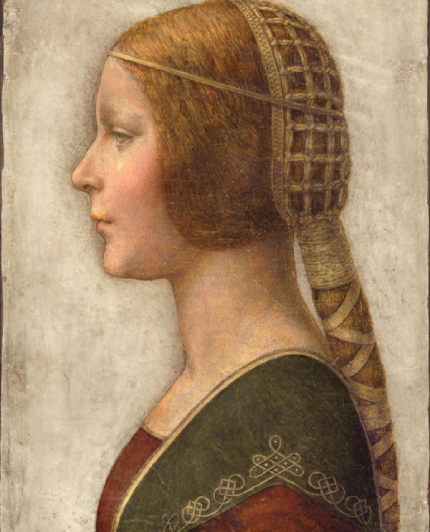
Leonardo di ser Piero da Vinci (1452-1519) translates to “Leonardo, son of (Mes)ser Piero from Vinci” indicating his father’s name and place of origin. His natural genius interweaved with so many disciplines that he epitomized the term “Renaissance man.” Considered one of the greatest minds in history, he epitomized the Renaissance humanist ideal (inherent value and potential of individual human beings.)
Leonardo’s parents were unmarried at the time of his birth. His father, Ser Piero, was an attorney and landlord in the town of Vinci; his mother, Caterina, was a young peasant woman. His parents, in subsequent unions, had a total of 17 other children, da Vinci’s half-siblings.
Da Vinci had no formal education beyond basic reading, writing and mathematics. His father appreciated his artistic inclinations, apparent at the age of 15, and apprenticed him to the noted sculptor and painter, Andrea del Verrocchio of Florence. In Verrocchio’s renowned workshop, Leonardo received multifaceted training in painting, sculpture and skills related to engineering and construction.
The extant examples of his work during this period include pen and pencil drawings with many technical sketches involving pumps and military weapons. He was fond of filling notebooks with inventions, observations about aeronautics and human anatomy. His imagination allowed him to create, on paper, the bicycle, the helicopter and an airplane based on the physiology and flight of a bat.
In 1482, da Vinci moved to Milan to work in service to the ruling Sforza clan. He was no doubt enticed by Duke Ludovico Sforza’s talented court and the academic atmosphere of Milan. Coincidentally, Milan was the center of medical exploration at the time. He served as engineer, painter, architect, sculptor and pageant creator for his wealthy patrons. The Sforza court was quick to notice Leonardo’s elegant bearing and gracious, but reserved, personality. He was frequently consulted as a technical advisor in the fields of architecture, hydraulic and mechanical engineering and military matters. This period of his life characterized a problem that plagued his life as a whole, setting boundless goals for himself resulting in much unfinished business.
As a painter, Leonardo completed six works in his 17 years in Milan. One of his extant works during this period is among the world’s most well-known and celebrated paintings. “The Last Supper,” is a tempura and oil mural created for the refectory of Santa Maria delle Grazie monastery. Measuring 15’x29’, it depicts the Passover dinner during which Jesus Christ addresses the Apostles and says, “One of you shall betray me. It is the artist’s only surviving fresco.
Coincidentally, one of his “unfinished business” projects during this period was a grandiose sculptural project that may have been the real reason he was invited to Milan. It was a monumental equestrian statue, 16 feet high, cast in bronze, to be erected in honor of Francesco Sforza, the founder of the Sforza dynasty. With occasional interruptions, da Vinci devoted 12 years to this project. The undertaking was finally doomed when the metal, ready to be poured, was instead used to make cannons for an impending war.
At some point in the early 1490’s, da Vinci began filling his famous notebooks related to four broad themes – painting, architecture, mechanics and human anatomy – resulting in thousands of pages of neatly drawn illustrations and densely written commentary. His reserved nature was evident in the notebooks as some were written in left-handed “mirror script” (letters are reversed and written in opposite direction to normal) making some of the notes indecipherable.
After the victorious entry of the French invasion of Milan in 1499, the Sforza family fled, da Vinci escaped as well, first to Venice and finally to Florence.
He received a prized commission to paint a mural for the council hall in Florence’s Palazzo Vecchio, an historical scene, “Battle of Anghiari”, twice as large as the “Last Supper” and unfortunately, unfinished after three years of effort. During these same years, he painted a number of portraits that included “La Gioconda,” an oil on white poplar wood panel, 31” tall x 21” wide, that is best known today as “Mona Lisa.”
The Florentine period was also a time of intensive scientific study for Leonardo, He did dissections in the hospital of Santa Maria Nuova and broadened his anatomical work into a comprehensive study of the structure and function of the human organism. He also made systematic observations of bird flight and his hydrological studies included the physical properties of water, the nature of water movement which he compared with those pertaining to air.
This period produced the Codex Hammer, a collection of data on the nature of water. It is written in Italian backwards and is considered one of the most famous of da Vinci’s surviving notebooks. The Codex is now in the property of software belonging to entrepreneur Bill Gates in Seattle.
He left Florence to enter the service of Cesare Borgia, the notorious son of Pope Alexander VI, commander-in-chief of the Papal army. Cesare Borgia, at age 27, was undoubtedly the most compelling and most feared person of his time. His ambitious aim, with unequaled ruthlessness, was to gain control of the Papal States of Romagna and the Marches.
Leonardo, twice his age, was fascinated by his personality. In service to Borgia’s ambitions, da Vinci was employed as an engineer to ford rivers with bridges, build siege weapons of war to subdue recalcitrant towns and fortify them once they had been captured. He participated in the siege of Arezzo, the subdued town of Urbino and on to exploits in Pesaro, Rimini and Romagna.
Historical fun fact: Leonardo da Vinci produced a colored, bird’s eye view map of Imola as part of an effort to fortify the town. This is probably the first example in history of a city map – drawn from a high vantage point – a cartographic convention that is still true in modern times.
When some of Cesare Borgia’s condotteri were plotting against him, Borgia acted first. He lured them to his headquarters with offers of gold and enhanced rank, killing them as soon as they arrived. This incident, dubbed the Senigallia Massacre, rippled throughout Europe, shocking many royal families. Leonardo resigned his commission with Cesare Borgia after the Senigallia Massacre and perhaps because Borgia began to contemplate the conquest of Tuscany, his native region.
Da Vinci’s “Portrait of a Man (Cesare Borgia?) is a surviving drawing from this episode in his life.
Several themes, because of da Vinci’s abundance of diverse interest, are said to unite his life in retrospect. He believed that sight was mankind’s most important sense and that “knowing how to see” was crucial to living all aspects of life to the fullest. He considered science and art as complementary rather than distinct disciplines; ideas formulated in one realm could, and should, inform the other.
Probably because of da Vinci’s abundance of interests and boundless curiosity, he failed to complete a significant number of his paintings and projects. The notebooks were testament to the enormous amount of time spent immersing himself in nature, testing scientific laws, dissecting human and animal bodies and contemplating and writing about his observations.
Leonardo da Vinci’s final years were spent in France after he left Italy for good in 1516. The French ruler, Francis I generously offered a royal patronage which afforded him the opportunity to paint and draw while living in a country manor, Chateau of Cloux, near Amboise. He was accompanied by his closest companion, Francesco Melzi, an Italian aristocrat from his days in Milan. Melzi inherited his estate. Da Vinci was buried in the palace church of Saint-Florentin. The church was nearly obliterated during the French Revolution and completely demolished in the early 1800’s, making it impossible to identify his exact gravesite.
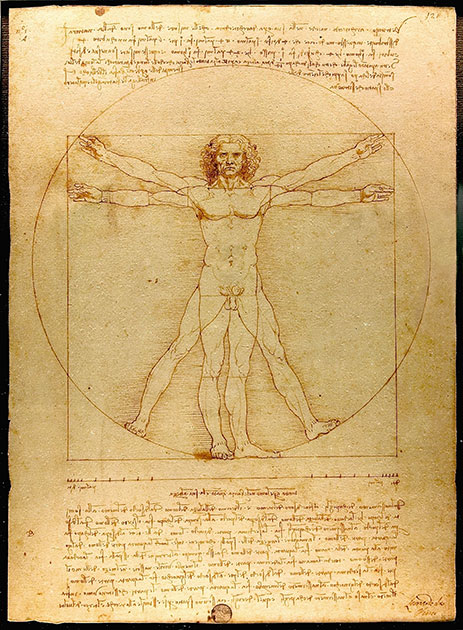
Leonardo da Vinci began his most penetrating anatomical studies when he was working for Ludovico Sforza in Milan. His eclectic interests, resulting in an encyclopedic knowledge of human anatomy, have come to define him. This iconic drawing represents da Vinci’s exploration of the ideal human body proportions inspired by the ancient Roman architect Vitruvius.
Based on what survives, clinical anatomists believe that his anatomical achievements were hundreds of years ahead of its time.
The Vitruvian Man is a prime example of such work. It explores the idea of proportion as both a work of art and a mathematical diagram. The medium for the diagram is pen, brown ink and watercolor over metalpoint (applying a stylus to a prepared surface) on paper usually made from clothing rags of hemp or linen. The measurements are 13.5” x 9.6.”
Fun fact: Artists have used metalpoint to create some of the most beautiful and technically accomplished drawings ever made. Interest in the medium peaked during the Renaissance when it was embraced by Leonardo da Vinci, Raphael and Albrecht Durer.
The mathematical diagram depicts an idealized male nude with four legs and four arms, allowing him to strike 16 poses simultaneously.
Fun fact: Da Vinci dissected over 30 corpses to study human anatomy in detail. His meticulous notes initially focused on the skeleton and musculature but then progressed into exploration about the mechanics of the human body. He wasn’t just interested in how things looked but also in how they functioned. The Vitruvian Man has been a part of the permanent collection of the Gallerie dell’Accademia in Venice, Italy. The piece is rarely exhibited because of its fragility.