RAFFAELLO SANZIO da URBINO, in English generally referred to as RAPHAEL, was an Italian painter and architect of the Italian High Renaissance (early 1490’s to 1527.)
He was a child prodigy and possessed a particularly charming personality that contributed later to myths about his cause of death.
Raphael of Urbino grew up in that city known for its cultural vitality and those early years constituted the basis for all his subsequent learning. Furthermore, the stimulation that surrounded him probably contributed to the exceptional precociousness of the young artist. By 17 years of age, he already displayed an extraordinary talent.
Renaissance, Italian for “rebirth”, was a cultural movement that centered on humanism, (characterized by self-reliance among common people and the belief in the uniqueness, dignity and value of human life) secularism, (emphasis on living well in the world and understanding political, economic, social and intellectual activities in the environment) and individualism, (focused attention on the personality and the uniqueness of an individual, particularly artists, to live up to their full potential.) Renaissance people valued the classical age; the time of the Greeks and Romans.

Raphael has been known as the supreme High Renaissance painter. His art epitomized the High Renaissance qualities of clarity of form, ease of composition and visual achievement, particularly the neo-platonic ideal of human grandeur (a metaphysical philosophy that flourished at that time that regarded the physical world which we experience as only a copy of another reality, an ideal that is Beauty.) The artist imitates this ideal reality through his genius.
Raphael moved around Italy as was typical of many artists of that time. Relocation brought new perspectives and new insights from some of the most significant artists of that time. His arrival in Perugia, around 1495, chronicled the young painter as a “master.” He received an important commission to paint an altarpiece, “Coronation of the Virgin” in the Oddi Chapel. During this period, he worked with the great Umbrian master, Pietro Perugino.
Moving from Perugia, Raphael arrived in Florence in 1504 (in his early 20’s.) In Florence, he came into substantial contact with an extraordinary artistic community, which included Leonardo da Vinci and Michelangelo, reinforcing all the ideas he had already acquired and opening him up to newer and broader perspectives.
Raphael’s early development coincided with the increase of oil painting in Italy. By the time he had settled in Rome, in 1508 to work on Pope Julius II’s papal apartments in the Vatican, all of his paintings were executed entirely in oil which allowed for greater depth of shadow and richer, sensual color.
Raphael mastered the signature techniques of the High Renaissance such as “impasto” (Italian word for mixture, gives texture to a painting as paint is thickly laid on a surface so that brushstrokes or palette knife marks are visible.) The range of his impasto in some of his paintings has few parallels in the work of earlier artists.
He also became a master of “sfumato,” in Italian meaning “to tone down” in painting or drawing. This minute, fine shading from areas of light to areas of dark, produces soft, imperceptible transitions between colors and tones.
Raphael’s reputation for having a wild sex life, magnified by his obvious physical appeal and charming personality, contributed to the myth that he died of syphilis in 1520 at the age of 37. The Pope sent Rome’s top physicians to tend to the ailing artist.
However, The Italian Society of Internal Medicine published an article that stated the painter likely died from a pulmonary disease similar to coronavirus and not brought on by exhaustion from frequent wild sex with many partners.
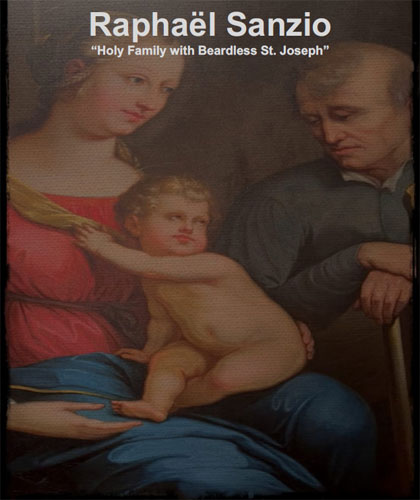
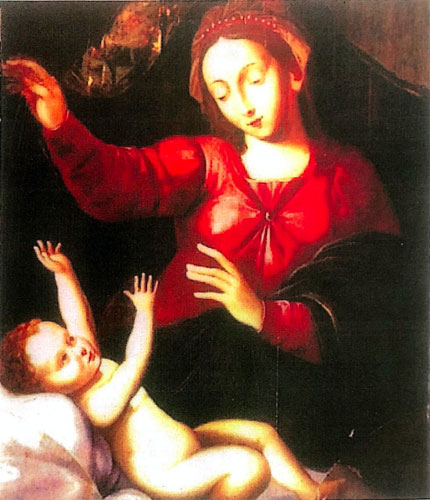
QPG is proud and honored to be able to offer into the marketplace two magnificent examples of Raphael’s work, “Holy Family with Beardless St. Joseph” and “Madonna of Loreta.”