
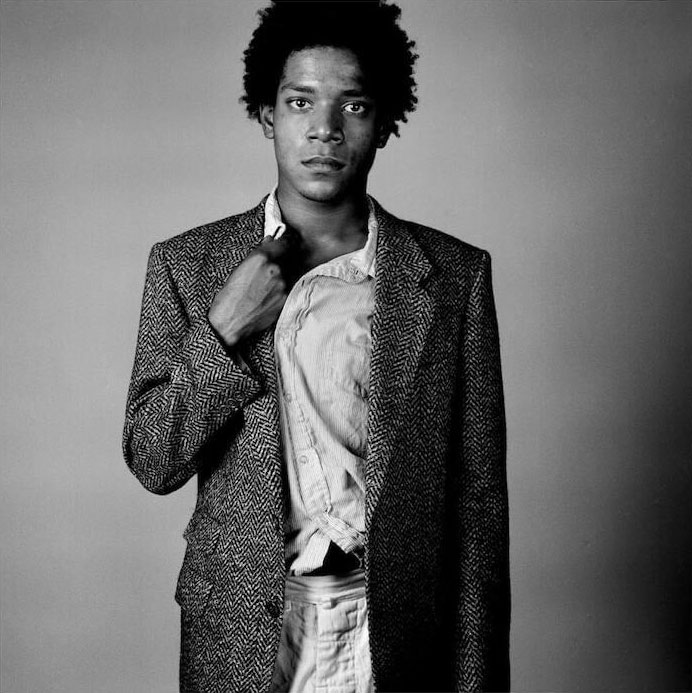
In November of 1982, Basquiat’s solo exhibition opened at the Fun Gallery in NYC’s East Village. A March, 1983 show quickly followed at the Gagosian Gallery in West Hollywood. He was accompanied by his girlfriend, then unknown singer Madonna who he described as “going to be huge.”
While in Los Angeles, Basquiat visited the artist Robert Rauschenberg and was profoundly inspired by the artist’s spontaneous, deeply personal expression especially in the freedom expressed in his technique which was characterized by a wide range of mediums (incorporation of everyday objects and materials) that blurred the distinction between painting and sculpture. “In Bed” (1955) was a typical example, a wall-mounted board covered with a pillow and patchwork quilt marked with graphite and paint. Rauschenberg challenged the traditional boundaries of art with his blended materials and methods.
Basquiat often painted portraits of graffiti artists. “Hollywood Africans” (1983) portrays him with graffiti artists Toxic and Rammellzee. That same year, he produced a hip-hop record “Beat Bop” featuring Rammellzee and rapper K-Rob. Basquiat created the cover art for the single, making it highly desirable among record and art collectors.
Upon returning to NYC in 1983, Basquiat joined Mary Boone’s influential SoHo gallery. His first show there in May 1984 featured a major work in his career, “Grazing/Soup to Nut” (1983) and several paintings, e.g., “Bird as Buddha”, “Eye” and “Untitled (Africa)”.
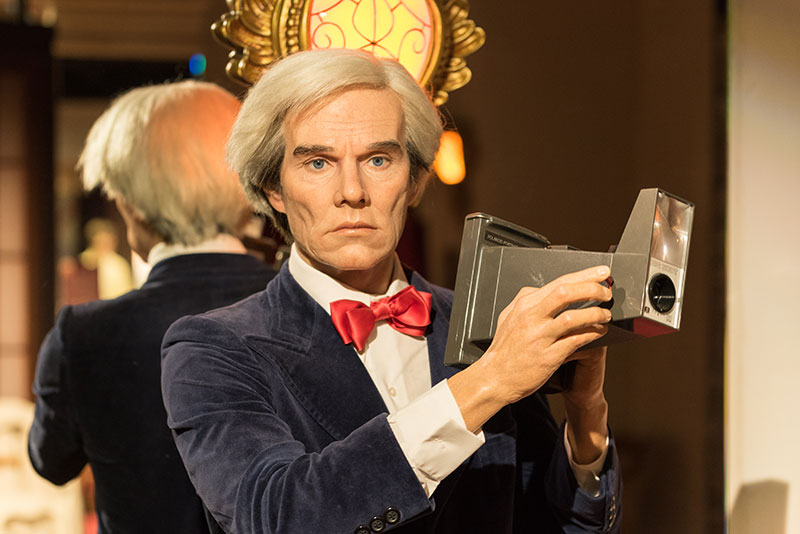
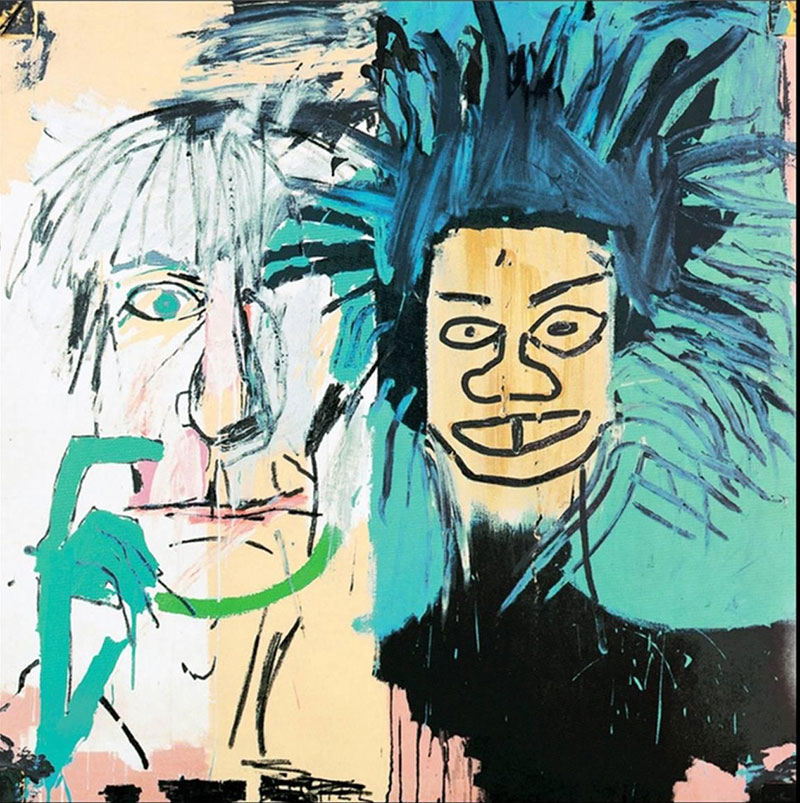
Basquiat worked with Andy Warhol for two years, 1984-1985. The collaboration was notable because it brought together two very distinct artistic styles, Warhol’s pop art sensibilities with its clean, repetitive imagery and Basquiat’s raw, expressive graffiti-inspired work. A dynamic visual dialogue erupted where each artist influenced the other, often layering their unique techniques onto the same canvas resulting in highly individualist and compelling artwork. When they collaborated, Warhol would start with something concrete or a recognizable image that Basquiat would subsequently alter in his animated style. “Olympics” (1984) and “Taxi, 45 th /Broadway (1984-85) are noteworthy examples.
Basquiat was astute when it came to publicity. He was particularly aware of the exploitative nature of the art industry and the pressures of being a black man in the white-dominated art world. He often painted in expensive Armani suits and appeared in public in the same paint-splattered clothes. He frequented New York hot spots like Palladium and Area nightclubs and sometimes worked the turntables as a DJ. He appeared on the cover of The New York Times Magazine in 1985 in a feature entitled “New Art, New Money: The Marketing of an American Artist.” He was also featured in GQ and Esquire magazines and walked the runway for a Comme des Garcons fashion show. The recognition he was receiving was a double-edged sword.
In the mid-1980’s, he was earning over $1M a year and receiving additional funds from art dealers. In spite of his success, his emotional instability continued to haunt him. The more money he made, the more paranoid he became from excessive drug use; heroin and especially cocaine.
1986 was a frenetic year for the artist. He went to Los Angeles for his last exhibition on the West Coast at the Gagosian Gallery in January. In February, he was in Atlanta for an exhibition of his drawings at the Fay Gold Gallery. In that month, he also participated in an “Art Against Apartheid” benefit. In the summer, he had a solo exhibition in Salzburg and walked the runway for Rei Kawakubo. In November, at 25 years old, Basquiat became the youngest artist to exhibit at Kestner Gesellschaft in Hanover, Germany.
1987 was a point of transition for Basquiat. He went in and abruptly out of a methadone program for heroin addiction in Manhattan and became basically a recluse. Drug use escalated and depression over the unexpected death of his friend Andy Warhol were contributing factors.
He travelled to Paris and Dusseldorf, among other places, for scheduled exhibitions. When he returned to NYC, he crossed paths with Keith Haring and Haring related that it was the only time Basquiat ever discussed his drug problem.
Despite numerous attempts at sobriety, Jean-Michel Basquiat died on August 18th 1988 of a heroin overdose at his home on Great Jones Street in Manhattan. The funeral was attended by immediate family and close friends. Keith Haring created the painting “A Pile of Crowns for Jean-Michel Basquiat” in his memory. Haring wrote an obituary in Vogue magazine. He stated, “He truly created a lifetime of works in ten years. Greedily, we wonder what else he might have created, what masterpieces we have been cheated out of by his death, but the fact is that he has created enough work to intrigue generations to come. Only now will people begin to understand the magnitude of his contribution.”
Shortly after his death, The New York Times indicated that Basquiat was “the most famous of only a small number of young black artists who have achieved national recognition.
Jean-Michel Basquiat’s canon revolves around single heroic figures: athletes, kings, warriors, policemen, musicians and the artist himself. The head is often the central iconographic focus of the images to convey complex ideas, themes or subjects that are important to different cultures. He topped the heads with halos and crowns representing an exalted intellect that is privileged over the physical body. He mixed his contemporary critique with poetry, drawing and painting to comment on historical context.
In his short but prolific career, Basquiat produced around 1,500 drawings, around 600 paintings and numerous sculpture and mixed media works. He drew in many different media, most commonly ink, pencil, felt-tip or marker and oil-stick
The art historian Fred Hoffman theorizes that Basquiat’s self-identification as an artist was his “innate capacity to function as something like an oracle, distilling his perceptions of the outside world down to their essence and, in turn, projecting them outward through his creative act.”
Art critic Rene Ricard wrote in his 1981 article, “The Radiant Child”: “I’m always amazed at how people come up with things. Like Jean-Michel. How did he come up with the words he puts all over everything, his way of making a point without overstating the case, using one or two words he reveals a political acuity, gets the viewer going in the direction he wants. One or two words containing a full body. What he incorporates into his pictures, whether found or made, is specific and selective. He has a perfect idea of what he’s getting across, using everything that collates to his vision.”